Jodhpur, India, the Blue City

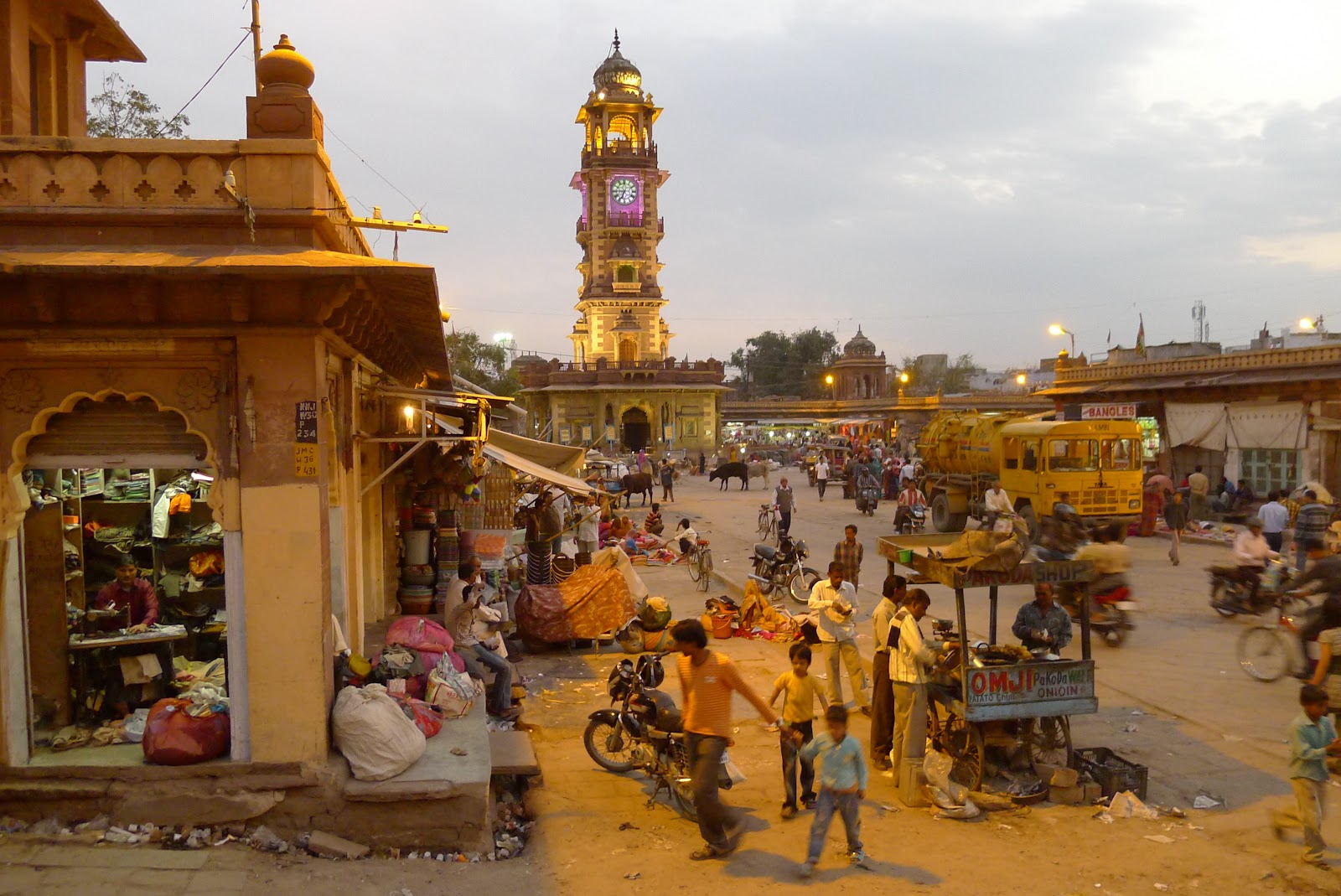
Jodhpur town square at twilight. Look at the activity, even as the day is winding down.
The tailor sewing, customers at the pakora cart. In the background, trucks and
motorcycles rage ahead near cows, and above it all - the ghost of the
British empire, the landmark clock tower.


Jodhpur - the Blue City, from the Fortress  the Mehrangarh
Jodhpur, the Blue City of Rajasthan

After an afternoon train ride from Jaisalmer, we arrived after dark at the bustling Jodhpur train station. We were quickly ushered out towards the cabs through the crowds, into the dark, noisy night.  Local travellers were sleeping outside, next to the station. Every free spot of ground was occupied. Something was moving at the base of the walls of the station....quickly and rythmically. Rats. Hundreds of rats, running in and out of cracks and holes in the walls of the station - scurrying around the  blanketed sleepers.  It was a startling but mesmerizing sight.  


In the Fort, Jodhpur, India


Busy, crowded, colourful, friendly.....Jodhpur.

Mr. Sharma, astrologer, in Jodhpur, India

The Mahrangarh

With only one full day in Jodhpur, we headed to the Mehrangarh. The formidable, impressive fortress of Jodhpur, the Mehrangarh, rises solidly on rock above the blue city. It houses cannons, gates and turrets, grand palaces,  jewelled rooms  of maharaja royalty and an interesting, popular museum. We  took the recommended audio tour. Famous astrologer, Mr. Sharma, read my palm and astrological chart inside the fortress. Astrology has been valued by the people of India since ancient times, and astrologers are consulted for many matters, including marriage compatibility. What better place for an astrological reading than India? 


The Mahrangarh in Jodhpur, Rajasthan, India


In the fortress at Jodhpur


Markets near the Clock Tower Landmark


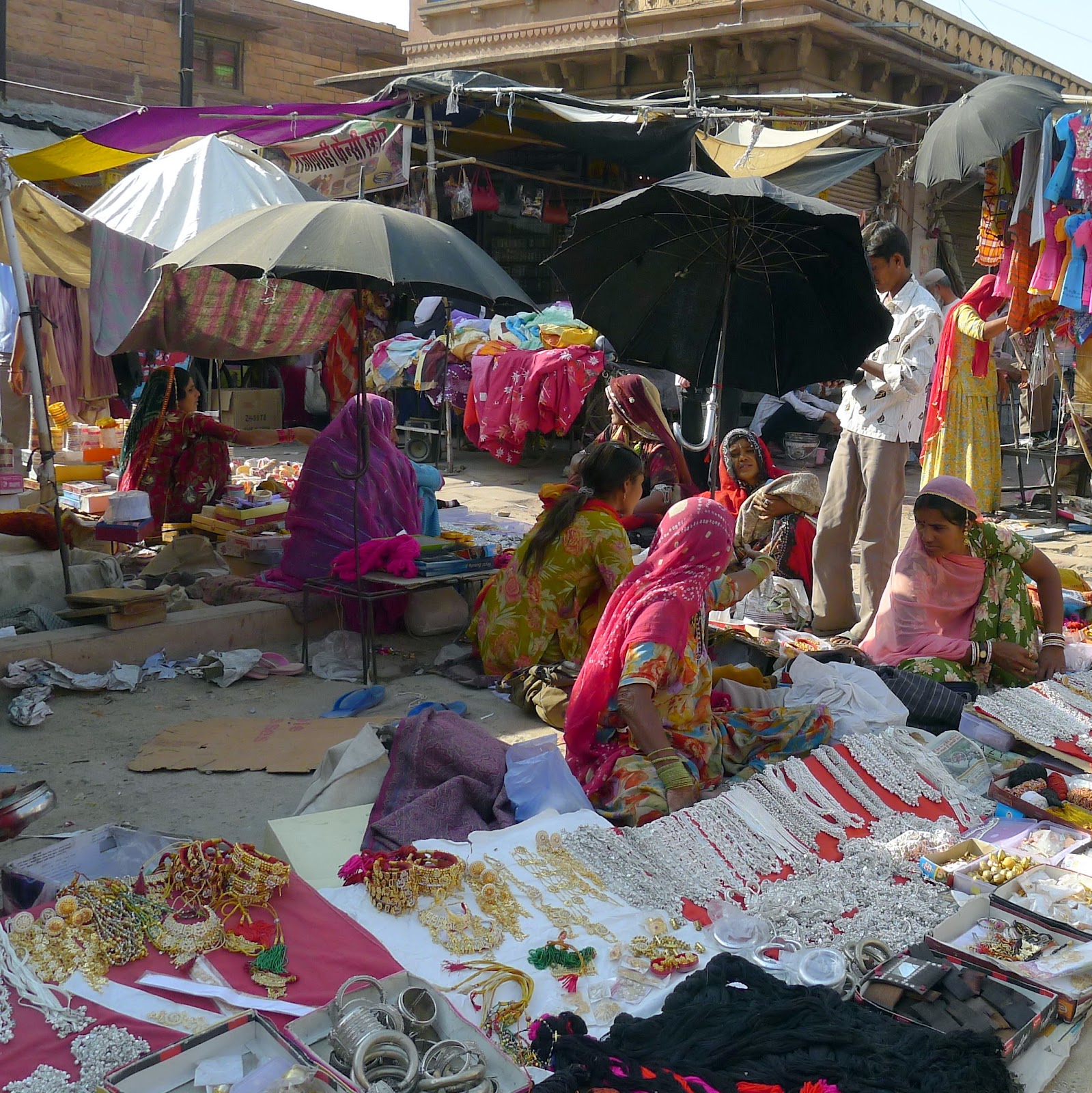
We walked around the lively Sadar market and the narrow streets and medieval bazaars of old Jodhpur. The marketplace was bustling, with crowds of local shoppers, carts with fresh produce and lunch foods, stores with teas and spices, beautiful bolts of fabrics, Rajasthani crafts, and household dry goods of all sorts. The friendly people of Jodhpur were happy to chat with us.  


Spices and friendly people in Jodhpur, India.


In the old town and marketplace in Jodhpur
Vibrant Jodhpur

Jodhpur, a city of just under a million people, is rich in the cultural history of Rajasthan. It has a rural feel about it. Jodphur was the most colourful of any of the places we visited in Rajasthan, with a panorama of blue buildings, dazzling neon fabrics, sparkling handicrafts, and brightly decorated auto-rickshaws, or 'tuk tuks', as we called them.

I love my pictures from Jodhpur - some of my favourites of the entire trip. We stayed two nights in Jodhpur, as planned. It's a place worth visiting, on any trip to Rajasthan.


Decorated tuk tuk in Jodhpur - behind a belching truck ...

....loaded with bright fabrics.


Negotiating a tuk tuk ride in Jodhpur. Only two passengers per tuk tuk- that's the rule.


Jodhpur


 Next stop......Udaipur via Ranakpur and the renowned Jain temple.


Dieppe, France. A Soldier's Story from WWII

clipping from the Windsor Star, August 1942.

The Dieppe Raid: August 19, 1942

Of the 6100 assault troops to land at Dieppe, 5000 were Canadians, many from Windsor, Ontario. Dieppe was a nightmare and a disaster for Canadian soldiers - over 900 Allied soldiers killed, 2000 captured, hundreds more wounded. Here is one soldier's story of the Dieppe raid on August 19, 1942.

My dad, Henry Charles Read, and his younger brother, William George Read, from Windsor, Ontario, were both soldiers at the Dieppe raid. They were Sergeants with the 11th Field Company, Royal Canadian Engineers. 

As engineers their orders were to get into the town of Dieppe, set explosives and blow up their target, which was a factory. They landed at Dieppe in the dark, before sunrise and before the majority of the Allied troops came ashore. The Germans were waiting for them, and there was heavy gunfire and shelling. 

My uncle Bill was wounded shortly after landing. His arm was badly injured and he was evacuated back to a hospital in England. My dad continued on with other engineers into the town of Dieppe where they set and detonated explosives, as ordered. 

Eventually, as the slaughter of Allied soldiers continued on the beach, the word came down the line from the Canadian command that the Canadian soldiers were to surrender to the Germans. My dad and a few of his buddies would have nothing of that. As he said, he wasn't going to sit out the rest of the war in a German prisoner of war camp. Instead, they surveyed the land and the beach and found a spot where they 'went into the water'. They waded out into the English Channel, where a Polish destroyer picked them up a few hours later, and they were returned safely to England.

For pictures of the day on the Dieppe Raid

A link to video of the Assault on Dieppe

A link to video footage of the Aftermath at Dieppe, August 19, 1942


Dieppe now......
The pebbled, rocky beach at Dieppe. Was it any wonder the tanks got stuck?
We traveled to Dieppe a few years ago.
Arrived by train
From the cliffs, it was evident that Dieppe could be easily defended by the Germans.
On main street, Dieppe, France.
Canadian War Memorial on the beach at Dieppe, France


Poppies growing near the beach at Dieppe, France

On August 19, the sun shines exactly through the maple leaf carved out on the monument, to match up with the cement maple leaf on the ground.


Jaisalmer, Rajasthan

Inside Fort Jaisalmer, view from a patio
Station in Jaipur
Jaisalmer in Rajasthan, India  is in the Thar desert, near the border with Pakistan. For security reasons, the airport isn't open. The remote location of Jaisalmer attracts few tourists. It exudes a tranquil charm. We left hectic Jaipur for Jaisalmer by train shortly after midnight and awoke next morning streaming through the Thar desert. We caught glimpses of peacocks along the tracks and viewed wind generators in the distance. 

We arrived in Jaisalmer, the Golden City, around noon. Fort Jaisalmer, built in 1156, rises on a sandstone ridge high above the desert. A third of the people of Jaisalmer still live in the old town inside the Fort. We stayed outside at the Hotel Fifu.
Jaisalmer Fort from Hotel Fifu

Hotel Fifu is in a rural neighbourhood within easy walking distance of the Fort. Above the guest rooms of this small hotel are several levels of comfortable dining and relaxation terraces with stunning views of the Fort and the surrounding desert. 

In the Jain Temple


Jain carvings

Jauhar handprints


Bobbi's Craft Shop 
 
Mr. Fifu hooked us up with local guide, Vivender, for a full day walk through the historic sites of Jaisalmer. We toured the Fort, old havelis, exquisite Jain temples, attended a Hindu celebration, and climbed up a  turret to a patio for tea and views of the Fort and the desert beyond. Interesting day.


Jaisalmer lies in the heart of the Thar desert. This is the land of snake charmers and camel caravans, where women wear bright neon scarves and dance with fire pots on their heads. The music is lively, crafts are colourful, the architecture medieval, and the people are friendly and unique with a rich culture.  


Village near the camp


Mr. Fifu organized a safari by jeep through the desert, where we slept in canvas tents, with camels nearby, ready for trekking. We watched the sun set over sand dunes, an entrancing, peaceful experience. After dark, there was energetic and beautiful Rajasthani folk music and dancing around the campfire by local Kalbelia folk artists - a highlight! 

Talented dancer at our campsite.


We visited Jaisalmer in early March, midway through our 3 week trip through Rajasthan. There is an annual performing arts festival in Jaisalmer in early February, which would be spectacular to see. Jaisalmer is fascinating in so many ways, and Hotel Fifu, too, was a special place. Summer is brutally hot in Jaisalmer, so check out the climate before you book - but go.


Our tents in the Thar Desert


After sundown - local talent

Thar desert near Jaisalmer, Rajasthan
Rajasthan  music and dance around the campfire.


Hotel Arches in Fort Kochi

Street scene near Hotel Arches 
Terrace view


In Fort Kochi we began each day with  breakfast on the serene rooftop terrace of our favourite hotel in Kerala, the Hotel Arches. The morning sky was always soft, breezes gentle, as the heat of the day had not yet set upon Fort Cochin. Through the treetops swooped tropical birds. In the distance we saw glimpses of the sea. This peaceful setting was perfect for an anxious traveller like me, new to India.


Das


On each of our 5 mornings on the rooftop terrace we were greeted by Das, a friendly dignified man, who brought us dark Keralan coffee, fresh juice and local fruits, eggs and toast, or a delicious masala dosa and coconut chutney. We dined within view of St. Francis Church, built in 1503, the oldest European church in India, and the original burial place of Vasco da Gama.


All of the staff at the Hotel Arches were considerate and sincerely kind. They arranged reliable transportation for us (Josie) from the airport and on to the tea plantations of Munnar. They quickly moved us to a lower floor, without request, upon seeing that I had injured my ankle - and they brought ice for the swelling- even at 3am.


The Hotel Arches itself was lovely in all ways. Rooms were large, perfectly clean, with air conditioning, TVs, and private baths. Free internet access was available in the hallway and there was an interesting collection of books for guests in the lobby.


There are fancier hotels in Fort Cochin, but I doubt that we will ever encounter the genuine sweetness of the staff we met at the Hotel Arches. The wonderful breakfasts, and the exceptional people at the Hotel Arches were a memorable part of our trip to Kerala. Thank-you Hotel Arches.


Balcony view and St. Francis Church